Kenya: Post-Election Violence Displaces Over 100,000 Children

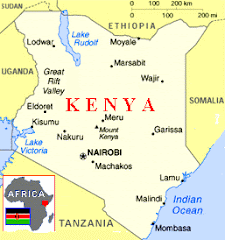
Kenya's bishops appealed to their countrymen to stop the "senseless killing of our brothers and sisters" and asked for an investigation into the December 27 elections that sparked violence. In a statement released Wednesday and signed by the archbishop of Nairobi, Cardinal John Njue, the Kenyan prelates said they witnessed "with deep sorrow and concern the outbreak of violence and the breakdown of law and order that has led to numerous deaths, injuries and destruction of property, creating fear and helplessness that has led many to flee from their homes. imageKenya erupted in violence after the general elections were decried as rigged. Incumbent President Mwai Kibaki, 76, was sworn in for another term just a few minutes after his alleged victory was announced. Some 500 people have been killed and thousands more displaced in the violence. Though the conflict sprung from the election, it has taken on tones of ethnic cleansing, with tribal fighting between the president's Kikuyu people and opposition leader Raila Odinga's Luo tribe, with other tribes joining in. 

The United Nations Children's Fund (UNICEF) estimates that at least 100,000 children have been forced to flee their homes due to the wave of violence that swept through Kenya following last month's disputed elections.The agency said that as many as 75,000 children are now residing in over 100 camps for internally displaced persons, while many thousands more children are believed to be living temporarily with other family members. Almost 600 people have lost their lives and some 255,000 others displaced during the crisis which began after President Mwai Kibaki was declared the winner over opposition leader Raila Odinga in the country's polls late last December.

UNICEF has prioritized the provision of life-saving interventions - including water, sanitation, shelter and nutrition - as well as the protection of children and facilitating their return to school. In the largest camps in the capital Nairobi and the western towns of Nakuru and Eldoret, the agency has established water and sanitation facilities by providing temporary latrines, water storage tanks, buckets and chlorine. So many have camped in the Eldoret Catholic diocese's Cathedral helped by the local Bishop Cornelius Korir. This is expected to help 50,000 people. Also in Kisumu and Eldoret, UNICEF is sending emergency health supplies to benefit more than 100,000 people. It is assisting Kenya's Ministry of Health to operate screening centres in camps to identify and treat malnourished children. An emergency polio and measles vaccination programme, de-worming and vitamin A distribution are also underway.

Huge turnout in Madrid affirms the family

Recognizing and fostering "the marvellous reality of the indissoluble marriage between man and woman", is "one of the greatest services which can be rendered nowadays to the common good and to the authentic development of individuals and societies, as well as the best means of ensuring the dignity, equality and true freedom of the human person". The Family Encounter Spain 2008

A huge family rally in Spain on the Sunday after Christmas got minor coverage in the international media but sent an unmistakable message to a Spanish government that has legalised homosexual "marriage", mandated pro-homosexual instruction in schools and made divorce easier. According to organisers, more than one-and-a-half million people gathered in central Madrid, where they heard speeches from church leaders and other public figures.

Pope Benedict addressed the Family Encounter (Encuentro de las Familias) in a live video link, saying that the family "founded on the indissoluble union between man and woman … is the place in which human life is sheltered and protected from its beginning until its natural end." The pope also said it was "worthwhile to fight for the family and marriage because it is worthwhile to work for the human being, the most precious thing created by God."

Spain has one of the world's lowest birth rates, thanks, in part, to an abortion rate that has climbed to over 100,000 annually since legalisation in 1985. In the last month the Spanish media has reported numerous cases of illegal late-term abortions, and one channel actually broadcast footage of two such procedures. Several abortion clinics in Madrid and Barcelona have been shut down and several doctors and clinic personnel are being prosecuted.

Community-based child-care providers

A colorful array of childcare and preschool options blossomed in the 1970s as the feminist movement spurred mothers into careers and community organizations nurtured new programs. Community Based children Care

Now a small circle of activists aim to bring more order to childhood. Their battle cry, heard in a growing number of state capitals and school reform circles, seeks to create a more standard, state-run preschool system. For young children already facing the rigors of play dates and harried parents juggling the strains of work and family, government is moving in to standardize childhood.

Sociologist Bruce Fuller traveled the country—sitting in preschool classrooms, delving into the birth of universal preschool in California and Oklahoma, and interviewing this robust movement’s eager leaders—to understand the ideologies of childhood and the raw political forces at play. He details how these new progressives earnestly seek to extend the rigors of public schooling down into the lives of very young children. Fuller then illuminates the stiff resistance by some children’s activists, ethnic leaders, and conservatives, who hold less trust in government solutions and more faith in nonprofits and local groups in contributing to the upbringing of young children.

The call for universal preschool is a new front in the culture wars, raising sharp questions about American families, cultural diversity, and the appropriate role of the state in the lives of our young children. How are state governments variably shaping universal preschool? Why does the state want to standardize childhood? Which children benefit from quality preschool? Will civic organizations grow weak as the state comes to run and regulate early education? Drawing on the voices of teachers, community activists, and political leaders actively shaping this debate, Standardized Childhood shows why the universal preschool movement is attracting such robust support—and strident opposition—nationwide.

Best Christmas gift: Time with MUM AND DAD!

Parents should spend more time baking, dressing up and making decorations with their children if they want them to have a truly memorable Christmas. They should spend less time tracking down the latest games console. A Happy African Family in Christmas That is the advice of a leading British charity which has published a 16-page guide, Batteries Not Included, to activities for the Christmas and New Year holiday. The free booklet contains more than 100 simple ideas, including making snowy footprints to show where Santa Claus has been, a treasure hunt and a home cinema evening. Kids are more likely to cherish the memory of such activities than the toys they get, says the society.

It is conducting a two-year investigation into modern British childhood and has discovered that children's No. 1 priority is spending time with their parents. Yet parents often give their kids gifts instead of time, said spokesman Tim Linehan. "We are not trying to write off TV or computer games … but these are more solitary pursuits than the games of the past. Our finding that children have fewer close friends than a generation ago, and that more children have no good friends at all, cannot be dismissed."

Moscow to have 'Year of the Family' in 2008

The government of the Russian has announced a "Year of the Family in Moscow" to run through 2008. The program, which aims to help any family in the city, includes events to educate and prepare young people for creating families and for strengthening family values -- especially among poor families and those with many children. It also aims to prevent children being abandoned by their parents with the creation of a new support center, specialized networks for foster care and the opening of a crisis center for people with children who have subjected to domestic abuse.

Moscow mayor Yuri Luzhkov says the idea is to support Russianall families who need help, not just those who already qualify because the parents are young (up to 35) or other distinct groups. The year of the family will continue privileges granted to large families, such as free transport and other services.

Because of low birth rates and high death rates Russia's population is in decline. But with the increase in the people's incomes in the 2000s Russia's demographic situation has started to turn around and families increasingly have a second and third child. Russia's fertility rate has climbed from a low of 1.2 to 1.39 in 2006. While still far below the 2.1 replacement rate, it continues to show signs of growing.

Live-in boyfriends raise risk of Child Abuse

Child Abuse Growing up in a home without both natural parents is a well-known risk for a child's welfare and cases of severe child abuse tend to confirm this, as a recent Associated Press article points out. But the article also notes that privacy concerns and fear of appearing judgemental prevents accurate assessment -- and public warnings -- of the risk posed by a mother's live-in boyfriend.

The most recent federal survey of child abuse in the US tallies nearly 900,000 abuse incidents reported to state agencies in 2005, but it does not delve into how rates of abuse correlate with parents' marital status or the make-up of a child's household. Data on the roughly 1500 child-abuse deaths annually leave similar unanswered questions. However, studies have found:

  • Children living in households with unrelated adults are nearly 50 times as likely to die of inflicted injuries as children living with two biological parents.
  • Children living in step-families or with single parents are at higher risk of physical or sexual assault than children living with two biological or adoptive parents.
  • Girls whose parents divorce are at significantly higher risk of sexual assault, whether they live with their mother or their father.

"All the emphasis on family autonomy and privacy shields the families from investigators, so we don't respond until it's too late," says researcher Robin Wilson, a family law professor at Washington and Lee University. "I hate the fact that something dangerous for children doesn't get responded to because we're afraid of judging someone's lifestyle."

Marriage deserves more because it gives more

HeteroSexual family The continued provision of preferential support for parents and children over other types of unions is vital for society. The ongoing debate in Australia over the access of same-sex couples to social benefits and so-called entitlements is a distraction from the real issue at hand. The real issue is not one concerning any infringement of rights. Rather, it is about what heterosexual Marriage can offer society that other forms of relationships cannot.

Married heterosexual unions are not simply a legal invention with an associated bunch of benefits. Committed, enduring heterosexual unions have an intrinsic value which enables them to provide a number of reciprocal benefits to any society. It is the reason why flourishing societies have always acknowledged the importance of marriage and family and accorded it a level of preferential support. It is a vital part of the social estate.

The social benefits of committed, exclusive heterosexual unions include the generation of children and the raising up of future citizens; a supportive and safe environment for the nurturing of these children; two parents who are biologically connected to their child and who are willing to sacrifice themselves for the sake of that child; two complementary parents who can provide appropriate gender role modeling; and an inter-generational connectedness within families and societies where parents are encouraged to save and provide for their children and grandchildren.

Reference: Marriage deserves more...